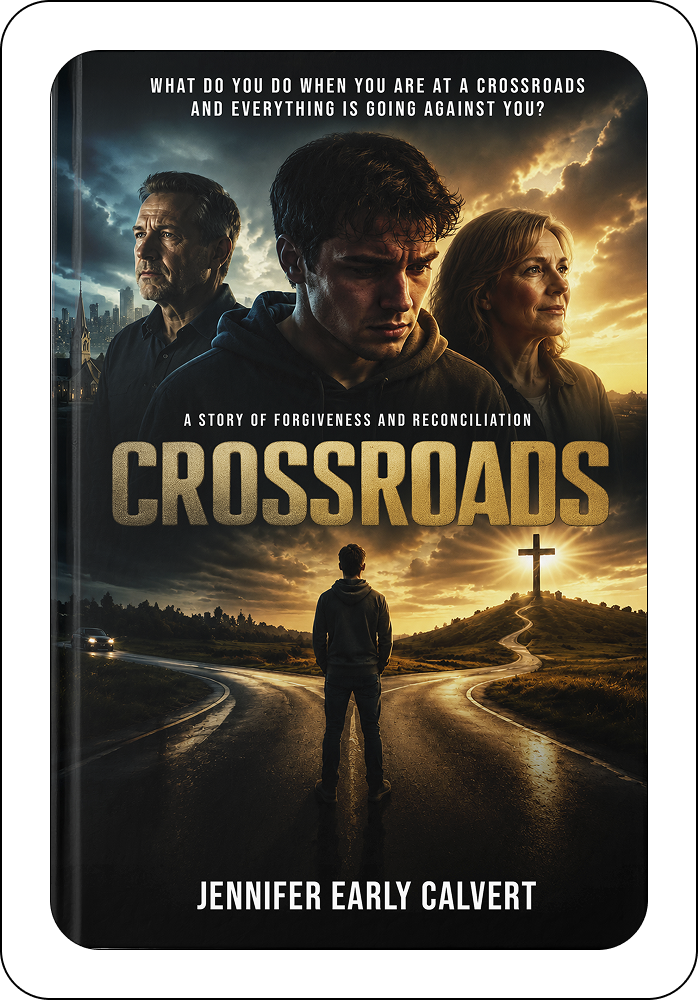

Can a young man accept forgiveness when he cannot forgive himself?
What happens when a pastor can preach grace to strangers but struggles to offer it to his son?
How do you build a future when every fresh start seems shadowed by the past?
And when life brings another crossroads, who gets to decide which road you take?
Kyle Johnson seems destined for success. At Harrington Military Academy, he leads the cadet battalion and excels at soccer. A scholarship to The Citadel promises college athletics and a route toward his dream of becoming a pilot.
Yet his confidence has a vulnerable side. As a child, Kyle watched his father, Pastor Tom Johnson, miss an important soccer game. He still craves approval.
Then an evening celebrating graduation goes terribly wrong. After drinking at a party, Kyle drives his Jeep along a rural road with two close friends. His reckless choice brings devastating consequences, and his plans collapse.
Jennifer Early Calvert’s Crossroads begins with a serious question: what does responsibility look like after an apology can no longer repair the damage?
Among faith based fiction books, stories of mercy can sometimes make reconciliation seem quick. Jennifer Early Calvert’s narrative refuses that convenience. Kyle faces legal consequences, scrutiny, and persistent grief.
Jackie Worthington, the mother of his friend Brent, gives the novel one of its most searching moral tensions. Her faith leads her toward forgiveness, although her loss remains painfully real.
Her position does not excuse drunk driving. During Kyle’s court hearing, she acknowledges his responsibility while asking that his remaining life not be destroyed. Mercy is not innocence.
Later, when Kyle abandons a school presentation because speaking about the accident overwhelms him, Jackie challenges him. She wants him to act despite his pain.
Forgiveness demands action, not instant relief.
Tom Johnson knows the language of compassion. His life revolves around church. Yet his relationship with Kyle exposes the distance between speaking about forgiveness and extending it under pressure.
Long before the crash, Tom’s strict priorities complicate Kyle’s love of soccer. Afterward, his disappointment makes home another place where Kyle feels judged by his worst decision.
The contrast with Jackie is striking. She has suffered a loss Kyle’s father has not, yet she reaches toward the young man Tom keeps at a distance. The contradiction troubles both men.
A sermon about the Prodigal Son becomes especially revealing. Kyle notices his father’s failure to act like the welcoming parent. But he must also confront the resentment shaping his own treatment of others.
Here, the novel insists that forgiveness cannot remain a standard imposed only on other people.
Jennifer Early Calvert gives Kyle’s struggle objects readers can picture. A scar across his hand, shaped almost like a cross, stays with him after the crash. He chooses not to have it repaired because he wants to remember.
Wind chimes once shared with Brent at school acquire a different significance after Kyle dreams of his friend. Kyle remains unsure what he experienced.
Neither object offers a neat cure. The scar recalls accountability; the chimes hold the possibility of comfort. Grief transforms ordinary things. His past stays visible even as hope returns.
People searching for books about forgiveness and second chances may recognize Kyle’s frustration when effort fails to produce immediate results. He passes technical tests, earns a job offer, and then learns that the offer has been withdrawn.
Friendships strain. Romance becomes complicated. Another friend faces grave injury, and Kyle’s old fear of losing people returns. Mental health and recovery enter the story.
These threads widen the story beyond a single accident. Kyle’s greatest challenge is learning that a painful history neither guarantees failure nor entitles him to a painless future.
Jenna, a young woman devoted to prayer and service, brings another perspective. Her medical ambitions matter independently. Their conversations ask whether love can grow without demanding that someone abandon a calling.
The novel moves between family conflict, friendship, romance, and questions of Christian belief. Its characters don’t always respond generously. They lash out, withdraw, doubt, and sometimes mistake punishment for genuine change.
That imperfection gives the religious questions substance. Faith appears in a grieving mother’s choices, a difficult conversation, and the decision to enter a counseling room. They resist easy answers.
Jennifer Early Calvert also pays attention to what public judgment can do. A newspaper story and employment form make Kyle question whether anyone sees beyond his conviction.
For those drawn to character-driven Christian fiction, Crossroads offers plenty to consider about accountability and belonging. Its most interesting question may be whether receiving grace teaches us to give it.
Yes. It follows Kyle Johnson as he struggles with guilt, faith, and accepting forgiveness after a tragic accident.
The story shows that forgiveness doesn’t erase consequences. Kyle still has to rebuild his life and relationships.
Older teens and adults who enjoy Christian fiction about family, grief, faith, and second chances.